

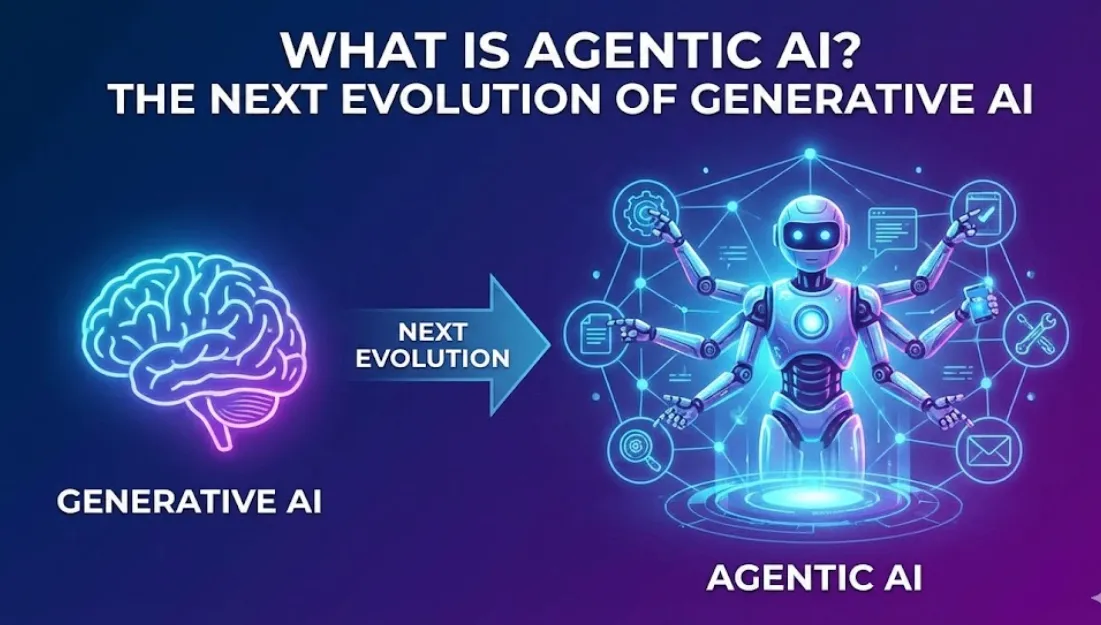
Have you ever stopped to think about how artificial intelligence might evolve from simply creating content to actually deciding on actions and completing tasks all by itself? This concept points directly to agentic AI, a significant leap in the realm of AI systems. In simple terms, agentic AI features AI agents that surpass the limits of generative AI through independent reasoning, planning, and execution to accomplish defined goals. Throughout this article, we will explore the essentials of agentic AI, its differences from other forms of technology, and how it applies in everyday scenarios, all aimed at giving you a comprehensive view of its place in business operations and beyond.
Agentic AI takes the accomplishments of generative AI to new heights, where large language models have already transformed the way we produce text, images, and various other materials. Still, generative AI primarily excels at generating responses to specific prompts, whereas agentic AI introduces proactive components that allow AI systems to operate with genuine independence. This development responds to the growing need for more intelligent and flexible tools across different industries, making it crucial for professionals who want to incorporate advanced AI into their daily routines. Consider the everyday hurdles in your job—might autonomous agents help simplify those and let you focus on more important matters?
Getting to the Heart of Agentic AI
To truly understand agentic AI, let’s tackle a basic query: What makes it different from conventional AI techniques? Agentic AI points to autonomous AI agents that perceive their environment, make choices, and carry out actions to achieve particular targets, doing so without requiring ongoing human guidance. These agentic AI systems blend reasoning, forward planning, and the ability to remember past events to navigate shifting circumstances, transitioning from straightforward utilities to complete goal-driven AI setups.
Fundamental characteristics encompass autonomy, where the system self-adjusts to incoming data in the moment. Reasoning involves using logical processes to assess possibilities and anticipate consequences. Planning means splitting objectives into manageable sequences. Memory entails keeping track of information from prior engagements to shape future responses. Tool integration allows connection to external elements like databases or APIs to finish assignments.
Such a structure empowers self-reasoning AI to address challenges that demand multiple phases, including organizing group meetings or examining data patterns. As an illustration, within a company environment, an AI agent might review key metrics, pinpoint crucial observations, and propose changes to procedures, continually refining itself based on accumulated experience. Take a moment to ponder your routine activities: How much effort goes into repetitive duties, and how could intelligent AI workflows transform that dynamic for you?
Key Components That Drive Agentic AI
Diving deeper, the success of agentic AI relies on several interconnected parts. Natural language processing serves as the foundation, enabling agents to interpret human instructions accurately and respond in ways that feel intuitive. Machine learning algorithms further enhance this by allowing the system to learn from interactions and improve decision-making over time.
Additionally, integration with big data sources provides the necessary fuel for informed actions, ensuring that AI agents draw from reliable, up-to-date information. This combination not only boosts efficiency but also builds trust in the system’s outputs, aligning with established standards for AI governance.
How Agentic AI Stacks Up Against Generative AI
One area that often confuses people is this: What separates agentic AI from generative AI in practice? Generative AI mainly deals with crafting original content, such as written pieces or graphics, derived from what users input. It functions in a responsive manner, offering results tied to those inputs yet lacking the initiative for broader pursuits.
Conversely, agentic AI enhances this foundation by incorporating proactive AI technology. It utilizes generative AI models as an initial layer but adds capabilities for making decisions and performing tasks. Picture this: While generative AI could prepare an email outline, an agentic AI system might compose the full message, scan schedules for suitable slots, and send it at the right moment, illustrating adaptive AI platforms effectively.
This separation underscores the advancement toward more refined AI systems. Generative AI established the base with its progressing models, but agentic AI advances into a fresh stage, positioning AI as an active collaborator in workflows instead of a passive aid. To gain more clarity, delve into analyses comparing AI agents to standard chatbots, which shed light on these fine distinctions. One helpful guide is AI Agent vs Chatbot: Sorting Out the Key Differences.
The Importance of Machine Learning in Agentic AI Development
Machine learning stands as a cornerstone for agentic AI, equipping these systems to absorb knowledge from data and hone their behaviors progressively. In agentic AI structures, machine learning algorithms enable AI agents to handle extensive datasets, recognize trends, and generate forecasts that guide their choices.
For example, reinforcement learning—a branch of machine learning—lets agents test different approaches and adapt according to results, similar to human learning through experimentation. This fusion guarantees that agentic AI systems gain precision and effectiveness, particularly in fluid settings where factors shift often. Companies can leverage this by employing machine learning models to fine-tune operations, like predicting requirements in supply chains or customizing engagements with customers. As you think about implementation, consider how machine learning might sync with your current data analytics efforts to elevate performance levels.
Integrating Machine Learning Models Effectively
When building agentic AI, selecting the right machine learning models matters greatly. Options like decision trees offer straightforward paths for simple choices, while more complex setups involving neural networks handle nuanced tasks. Proper integration involves training models on diverse datasets to avoid biases, ensuring outputs remain fair and reliable.
Breaking Down How Agentic AI Works Step by Step
To see agentic AI in operation, let’s outline its process as though constructing one from the beginning.
First, the system accepts or sets a goal, such as enhancing efficiency in a supply chain, and deciphers it via natural language processing.
Second, the AI agent assembles pertinent information from origins like sensors, documents, or user contributions.
Third, it strategizes and reasons using methods like reasoning and action frameworks, charting out necessary steps. For intricate situations, it employs sequential reasoning to review alternatives.
Fourth, the agent engages with outside resources, possibly APIs for data extraction or programs for automation, to implement the strategy.
Fifth, upon finishing, it examines the outcomes, preserves insights in its memory, and adjusts techniques for subsequent uses, frequently drawing on machine learning.
This iterative process fosters ongoing improvement, positioning agentic AI as ideal for unpredictable contexts. In real terms, developing these systems requires choosing appropriate large language models and emphasizing robust data management to uphold accuracy. Which particular aim could you assign initially to experiment with an AI agent in your environment?
Common Pitfalls in Agentic AI Implementation
While setting up agentic AI, watch out for issues like inadequate data quality, which can lead to flawed decisions. Ensuring compatibility with existing infrastructure prevents disruptions, and regular testing helps identify weaknesses early.
Exploring the Various Types of AI Agents
Agentic AI covers a range of types, each tailored for distinct purposes. Drawing from standard categorizations, the primary ones include:
Basic reflex agents respond solely to present stimuli without historical recall, suitable for uncomplicated monitoring roles.
Model-based reflex agents maintain an internal representation of their surroundings, facilitating management of incomplete observations.
Goal-oriented agents concentrate on fulfilling aims, determining optimal routes amid options.
Utility-focused agents appraise actions according to their value, juggling multiple priorities.
Learning agents progress through encounters, applying machine learning to achieve superior outcomes.
Hierarchical and multi-agent configurations coordinate numerous agents for elaborate assignments, such as in supply chain management.
These diversities enable personalized applications, spanning individual automations to sophisticated networks. In picking a type, reflect on your specific demands: For resource distribution, a utility-based agent might prove especially useful, supporting more informed selections.
Choosing the Right AI Agent Type for Your Needs
Factors like task complexity and required autonomy guide the selection. For instance, in enterprise environments, multi-agent systems excel at collaborative efforts, while simpler reflex agents handle routine checks efficiently.
Everyday Applications of Agentic AI Across Industries
Agentic AI is reshaping numerous fields right now. Let’s look at some tangible examples to demonstrate its influence.
In the healthcare sector, AI agents process patient information to recommend treatment options, interfacing with electronic records for individualized care. Within finance, they identify unusual patterns in transactions promptly and inform relevant teams.
Customer service improves with agents that address queries independently, escalating matters only as required. Creative domains employ them in content creation pipelines, such as crafting video outlines from emerging trends. For anyone focused on content creation, solutions like LensGo AI show how agents can ease workflows—take a look at this LensGo AI Review: Is It Worth It for Content Creators?.
In software development, coding agents support developers by producing and validating code segments. A relevant evaluation appears in Cursor AI vs GitHub Copilot: AI Coding Showdown, detailing their agentic attributes.
These cases emphasize the extensive applicability of agentic AI, spurring innovation in diverse areas.
Agentic AI in Healthcare and Clinical Research
Beyond general uses, in clinical trials, agentic AI aids in patient enrollment by analyzing eligibility criteria and matching profiles. It also monitors for protocol deviations, maintaining study quality and facilitating regulatory submissions through evidence synthesis from biomedical literature.
Enhancing Customer Service and Streamlining Business Operations with Agentic AI
Turning to customer service, agentic AI revolutionizes business interactions via conversational AI, delivering swift and precise replies. Virtual assistants driven by agentic frameworks can solve problems, suggest items, and even foresee customer requirements using historical data.
On a larger scale for business operations, agentic AI facilitates workflow automation, including HR automation for talent acquisition or accounts payable for invoice processing. It connects with ERP systems to optimize data collection and autonomous decision-making, minimizing manual involvement and inaccuracies. In supply chain management, for one, agents can project demands, manage load balancing, and respond to interruptions instantly, keeping everything running smoothly. Organizations aiming to adopt this approach should begin by identifying critical areas where process automation yields the greatest impact.
Boosting Efficiency in Supply Chain and Marketing
In supply chains, agentic AI integrates with predictive AI to forecast market analysis and adjust to renewable energy sources in energy demand forecasting. For marketing, it generates marketing copy and handles email marketing tools, ensuring consistent customer communication.
The Clear Benefits of Agentic AI in Business Settings
Incorporating agentic AI into daily operations delivers noticeable advantages. It increases productivity by managing standard tasks, enabling groups to devote energy to strategic initiatives. It also lowers expenditures through optimized resource utilization and reduced errors.
Furthermore, it refines decision-making with data-backed perspectives derived from broad sources. It elevates customer experiences via tailored and timely exchanges. Studies indicate that companies can realize efficiency improvements of up to 40 percent in domains like supply chain optimization. To fully capitalize on these, merge agents with prevailing systems and stress ethical guidelines.
Measuring ROI from Agentic AI Adoption
To gauge success, track metrics like time saved on tasks and error rates. Businesses often see quick returns in areas like customer support tickets resolution and knowledge base content management.
Navigating the Challenges and Potential Risks of Agentic AI
No innovation comes without its difficulties. Agentic AI confronts matters such as safeguarding data privacy, complying with regulations like the EU AI Act. Ethical dilemmas, including biases in determinations, necessitate alignment with protocols like the NIST AI Risk Management Framework.
Technical complications, such as perpetual reasoning loops, require firm defenses like human supervision. Substantial resource needs can burden infrastructures, highlighting the importance of expandable solutions.
By adopting strategies including activity tracking, intervention options, and periodic reviews, enterprises can lessen these concerns, fostering dependable applications.
Strategies for Effective Risk Management
Implementing identity and access controls, along with machine-to-machine authentication, strengthens security. Regular audits and policy enforcement ensure ongoing compliance with regulatory standards.
Ethical Dimensions and Governance in Agentic AI
With the expansion of agentic AI, ethical considerations and AI governance take center stage. This encompasses promoting transparency in decision processes and applying policies to avert improper use. Regulatory bodies establish benchmarks for controls, particularly in enterprise environments.
In fields like clinical research or financial systems, fulfilling regulatory requirements sustains credibility. Agentic AI systems ought to feature reflection and self-correction to conform to ethical norms, diminishing risks in AI-human interactions. Entities can establish authority by recording adherence and disseminating optimal practices in risk management.
Building Trust Through Transparent Practices
Transparency involves clear documentation of how agents operate, including code interpreters and orchestration frameworks. In hybrid-cloud environments, using vector databases and API orchestration layers supports scalable, trustworthy deployments.
Top Agentic AI Tools and Platforms to Consider
A variety of platforms simplify the embrace of agentic AI. IBM watsonx Orchestrate assists with workflow automation, whereas AWS Amazon Bedrock enables customized agent creation. Google Cloud Vertex AI Agent Builder supplies instruments for developing conversational AI.
Open-source alternatives like LangChain afford developers adaptability. For skill-building, examine offerings in Inspirit AI vs. Veritas AI: Which Program Suits Your Goals?.
When evaluating tools, prioritize seamless integration and conformity attributes. Kick off with trial initiatives, staff education, and oversight of performance indicators.
Comparing Leading Platforms for Beginners
For newcomers, platforms like Oracle AI Agents offer specialized features for enterprise needs, such as Fusion Cloud SaaS integration. Weigh factors like ease of use and support for machine learning algorithms.
Envisioning the Future Trajectory of Agentic AI Technology
Moving forward, agentic AI is poised to merge more thoroughly with multimodal functionalities, seamlessly processing text, imagery, and sound. Developments in multi-agent cooperation might overhaul industries including autonomous vehicles or forecasting energy demands.
Nevertheless, robust governance remains essential. Directives from entities like IEEE underline the need for openness and accountability. As the field progresses, look for extensive incorporation into common utilities, ranging from residential smart devices to corporate tools.
Linking back to generative roots, resources such as AI Video Prompts: Your Guide to Creating Viral YouTube Shorts with 10 Proven Examples reveal how agentic components amplify creative endeavors.
In summary, agentic AI represents a critical progression in artificial intelligence, facilitating proactive and astute AI systems. By comprehending its mechanisms and implementations, you equip yourself to utilize its capabilities. What initial step might you take to integrate this innovation? For additional authoritative perspectives, explore Orbit River for further resources on AI advancements.