
People often mix up AI agents and chatbots, but as artificial intelligence keeps advancing, spotting what sets them apart really matters for anyone looking to improve customer support or automate tasks. In 2025, with tools like large language models shaping how we interact with tech, understanding these differences can guide better choices in business and everyday use. This piece dives into the details, explaining how machine learning and natural language processing make each one tick, while highlighting practical examples and future shifts.
Breaking Down What an AI Agent Really Is
An AI agent stands out as a smart piece of artificial intelligence built to tackle jobs on its own, without needing constant guidance. It pulls from machine learning techniques, things like decision trees and neural networks, to sift through data and decide on next steps. This setup lets it deal with multi-step workflows, say in managing stock levels or spotting fraud in big enterprise resource planning platforms.
Take generative AI, for instance—it boosts what an AI agent can do by creating responses that fit the situation, drawing from huge pools of structured data and unstructured data in a knowledge base. That means the agent holds onto persistent memory, remembering past chats to offer help that feels tailored, almost like chatting with someone who knows your history.
Essential Parts That Make AI Agents Work
Digging deeper, AI agents rely on natural language understanding to get user inputs right. They use intent recognition to figure out what someone really wants from a question. In customer relationship management setups, an agent might run sentiment analysis to pick up on feelings and tweak its reply accordingly, keeping things in tune with how the user seems to feel.
Then there are API integrations, which let AI agents link up with other systems without a hitch. This paves the way for workflow automation, handling everything from routing support tickets to sorting out financial reconciliations. Features like these position AI agents perfectly for tricky spots that call for solid planning and execution.
How AI Agents Handle Real-World Complexity
Unlike simpler tools, AI agents thrive in uncertain environments. They make independent calls and roll out strategies across multiple steps to solve tough problems. For example, in a busy e-commerce operation, an agent could pull together market info, predict trends, and adjust plans on the fly, showing off its edge in dynamic settings.
Getting a Grip on Chatbots and How They Operate
Chatbots form the backbone of conversational AI, mainly there to dish out scripted responses for everyday questions. They shine in spots where fast, no-frills exchanges happen a lot, like fielding customer FAQs or walking someone through checking an order status.
At their heart, chatbots lean on natural language processing to break down user inputs and match them to set patterns. Still, they don’t dive as deep as AI agents, often sticking to rule-based approaches over heavy machine learning. That keeps them great for basic stuff but less so for anything that needs layers of context or back-and-forth tweaks.
What Chatbots Do Well and Where They Fall Short
A big plus for chatbots is their knack for consistent answers pulled from a knowledge base, making them a go-to for bustling customer support lines. They can even weave in speech recognition for voice assistants, opening doors for tasks like swapping a flight booking or kicking off a refund process.
But challenges show up in shifting scenarios. Lacking things like persistent memory or generative AI smarts, chatbots might pass off knotty issues to people, which could ding customer satisfaction scores. Compared to AI agents, they don’t jump into support automation or nurturing sales prospects on their own.
Everyday Uses for Chatbots in Business
In retail, a chatbot might handle quick queries about products or availability, pulling from a database to keep things moving. This reliability stems from their design for high-volume, low-variety interactions, but it also highlights why they pair well with more advanced systems for fuller coverage.
Putting AI Agents and Chatbots Side by Side
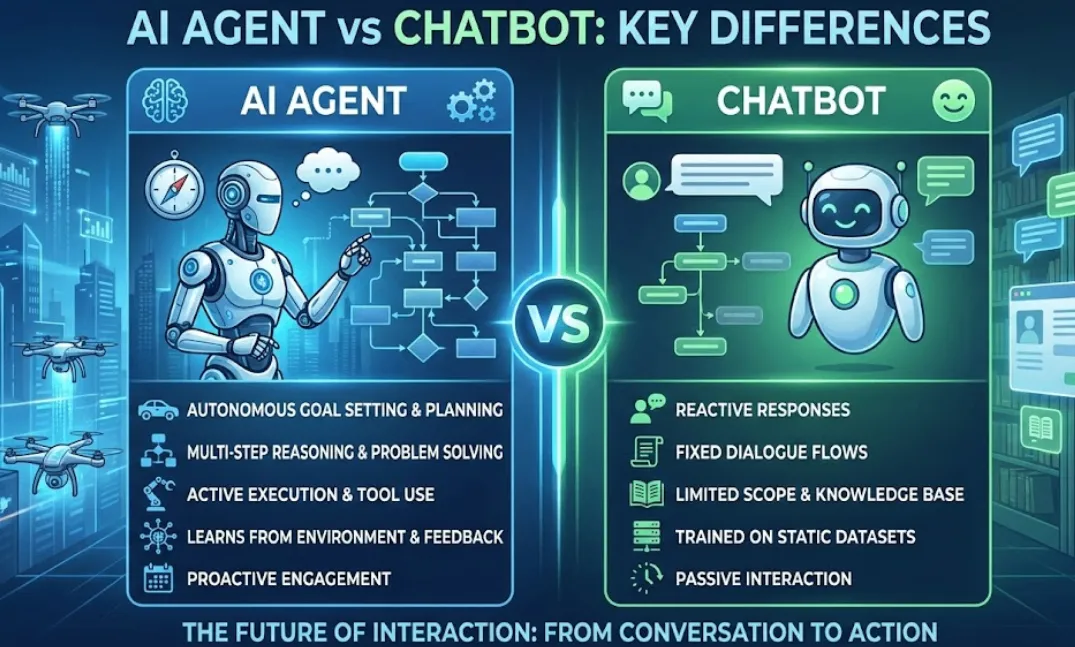
Laying out an AI agent against an AI chatbot reveals clear gaps. Autonomy tops the list; AI agents push forward with proactive moves, reading data to foresee what comes next, whereas chatbots hang back, only reacting to direct pokes.
On tasks, AI agents juggle detailed processes with large language models and decision trees, letting them update CRM systems or oversee inventory management. Chatbots keep it to straightforward talks, maybe noting disposition codes or basic fixes.
How they learn differs too. AI agents grow smarter through machine learning, picking up on fresh user patterns. Chatbots could get tweaks but don’t naturally evolve from ongoing use.
What This Means for Day-to-Day Operations
Businesses weighing options should think about their setup. For boosting customer experience, AI agents bring multilingual support and responses that consider the full picture, cutting down on human hand-holding in support operations. That leads to smoother runs in digital workflows and quicker incident response.
Chatbots offer an affordable start for routine automation, like dealing with sales prospects or curating content. Blending them with API-driven tools can fill in weaknesses, especially in team-based AI environments.
Here’s a quick table to sum it up:
| Aspect | AI Agent | Chatbot |
|---|---|---|
| Level of Independence | Strong, handles decisions solo | Weaker, sticks to scripts |
| Handling Complex Tasks | Tackles multi-step workflows and links | Best for simple back-and-forth |
| Adaptation and Learning | Improves with machine learning over time | Mostly fixed, needs manual changes |
| Taking Initiative | Starts actions from predictions | Only answers when asked |
These points show why AI agents are pulling ahead in areas craving robust artificial intelligence.
Autonomy in Action: A Closer Look
Autonomy isn’t just buzz—it’s what lets AI agents iterate through steps, refining as they go, while chatbots stick to one-off replies. This gap matters in 2025, as customer support shifts toward agents that grasp context and act on it.
Why Go with AI Agents: The Upsides
Bringing AI agents into the mix pays off for companies in several ways. They amp up customer support by streamlining workflows, which bumps up customer satisfaction scores with speedy fixes. In finance, they mesh with fraud detection systems to watch deals live, using natural language commands for easy control.
They scale well too, taking on more without needing extra hands. As digital labor, they shoulder repeat jobs, giving teams room for bigger-picture work. Backed by models like OpenAI’s or IBM Granite Llama models, they handle proprietary data safely.
Driving Efficiency Gains
Those gains spill into customer lifecycle automation, where agents cultivate leads and oversee cross-channel talks. With knowledge graphs in play, they deliver spot-on insights from data, outshining old-school chatbots in layered setups.
Following rules like role-based access control builds trust, guarding against online attacks and keeping system performance steady.
Measuring the Impact on Productivity
Studies from 2025 show AI agents cutting response times by up to 40% in support roles, thanks to their proactive stance. This kind of boost comes from their ability to automate beyond basics, into areas like self-service autonomous tools.
AI Agent Examples from Various Fields
Examples bring this home. In online shopping, AI agents tweak prices on the spot with generative AI, scanning markets to lift earnings. That beats what chatbots do, which might just pitch items from simple asks.
Healthcare sees cognitive agents tracking patient info, flagging problems with predictive tools. Multi-agent systems team up, one on diagnostics, another on bookings.
Creative work gets a lift too, with agents in apps like Duolingo Max or Slack AI. For more on tools, check LensGo AI Review: Is It Worth It for Content Creators?. It covers how agentic AI aids in making content.
In learning, setups in Inspirit AI vs. Veritas AI: Which Program Suits Your Goals? use AI assistants for custom teaching.
Emerging Use Cases in 2025
This year, AI agents pop up in voice virtual agents for hands-free help, or in collaborative AI tools for team projects. Think Talkdesk Autopilot for support or Salesforce AI on the Agentforce 360 Platform for sales flows.
Looking Ahead: AI Agents Past 2025
Heading into 2026, AI agents look to fold in bits of artificial general intelligence. Trends lean toward stronger team-based tools for things like headless browser automation or enterprise resource planning.
Ethics stay front and center, with rules pushing for clear views into large language models. Proactive AI will norm out, refining chats with sentiment analysis.
Try guides like How to Create Your Own Perchance AI Roleplay Character for interactive agent fun. Or read The Truth About Inspirit AI: Legit Pre-College Program or Marketing Hype? for solid AI learning takes.
For niche spots, Private Investigator AI: Top Transcription Tools shows agent roles in data work. And The 5 Best Features of LensGo AI You Need to Try Today spotlights real integrations.
Challenges on the Horizon
No tech is perfect—AI agents face hurdles like ensuring security solutions against threats such as malformed data or SQL commands. Prompt engineers play a key role in fine-tuning to avoid glitches.
Trends Shaping the Future
By 2025’s end, expect more focus on foundation models for smarter agents, blending with IT agents for seamless ops. This evolution points to agents handling even more in customer FAQs and beyond.
Picking the Best Fit for Your Setup
Figuring out if an AI agent or chatbot fits boils down to your needs. For spots needing voice assistants or standalone tools, AI agents deliver more. Kick off with checks on integrations, like with GPU Droplets for heavy lifting.
Lean on advice from places like NIST for trustworthy AI, making sure you dodge risks like third-party cookies in data handling.
Steps to Implementation
Start small: Assess your current system, test pilots, and scale up. Factor in things like context tracking and automating workflows to get the most out.
Wrapping It All Up
In the end, artificial intelligence’s growth makes AI agents standout partners for better customer experience and smoother runs. Getting these differences helps pick tools that fuel progress in a digital age.