


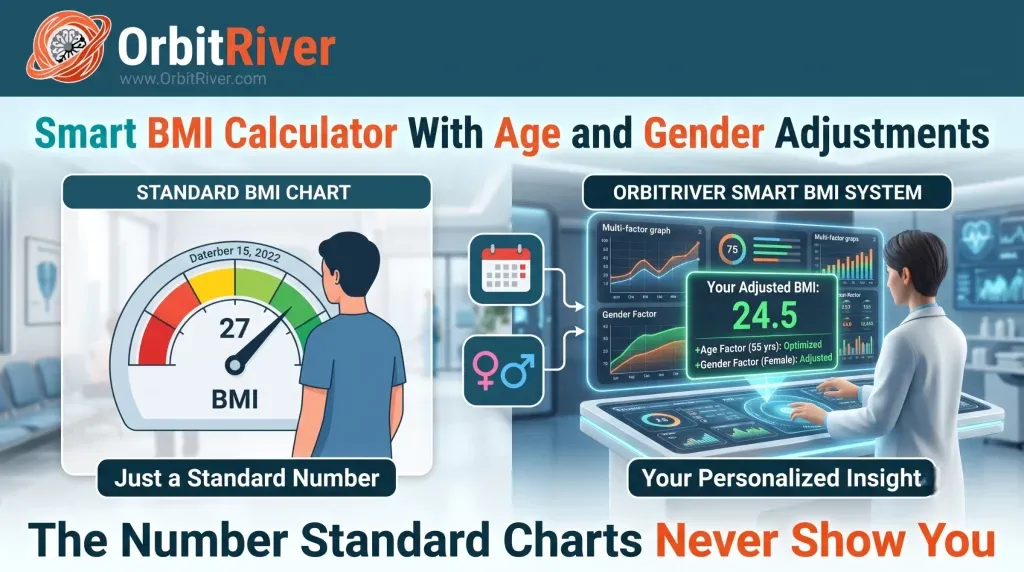
Enter your weight and height into every BMI-calculator on the top of results of a search and you’ll get the same number as the universal truth. A powerlifter who is 27 years old or a 61-year-old woman 3 years older than menopausal or a 45-year-old sedentary office worker all can land on 27.4 and receive exactly the same thing. Their health risks are not even close to being the same.
This is the issue that the adjusted BMI calculator was designed to address. Our calculator is included in StepFit, a free StepFit fitness and health calculator along with TDEE, pacing water intake, step-to-miles tools. There is the option of registering without a sign-up wall.
What does a clever BMI calculator can do better than a standard calculator does not
Answer straight away: a smart BMI calculator adds your gender and age to calculate your BMI score, then compares it against the risk factors for people who belong to your own demographic rather than against an all-encompassing 18.5-24.9 band. The basis of the calculation is the same. The interpretation is individual.
The concept was not developed by marketing. Smart Body Mass Index Smart Body Mass Index was created by a biologist Christian Bachmann with physicians David Fäh and Heinrich von Grünningen, and it was calibrated against health risk data from more than 3 million people, resulting in more acceptable BMI guidelines for women, young adults, as well as for individuals over seventy.
The reason the standard index fails so often?
Adolphe Quetelet published the ratio in 1835 as a general population statistic in 1835. It was not designed to determine the identity of the individual.
Research studies have laid out the limitations clearly: for people who are 20 or older, the conventional BMI utilizes only weight and height, and does not account for neither gender nor age but a woman usually has higher body fat levels than a male with the same weight and an older person has more body fat than a younger. Johns Hopkins geriatricians add that BMI is usually not as accurate after 65, as it doesn’t reflect changes in muscle tone and fat, as well as sarcopenia. can render the “normal” score inaccurate.
Scale is a factor here as well. NCHS figures indicate 40.3 percent prevalence of obesity among adults across the United States during August 2021-August 2023. This is the highest rate among people between the ages of 40 and 59exactly the same group that has body composition charts show the lowest.
Smart BMI compares to the traditional BMI calculator
| Factor | Traditional calculator | Adjusted calculator |
|---|---|---|
| Inputs | Height and weight | Height, weight, age, gender |
| Output | One point Four fixed categories | Score plus demographic-referenced interpretation |
| Adults who are over 65 | Often, weight is overstated. | Muscle loss is a factor in the decline in height |
| Women | Similar thresholds to males | Recognizes the presence of higher levels of body fat as a baseline |
| Athletes | Often flags muscle as overweight | It’s time to do a waist or body-fat cross-check |
| Children 2-19 | Usually, it is not supported | It was analyzed through percentiles and z-score algorithm |
| Best use | Screening of the population | Individual planning and monitoring |
How can you determine the most accurate BMI for your gender and age
- Check your height with shoes off and weight prior to breakfast by using the same measurement scale every time.
- Choose imperial or metric. The calculation involves weight divided into kilograms and height measured in meters squared. For imperial multiply the pounds by 703 then divide by the height by inches.
- Enter the gender and age so that the result can be read against the appropriate reference band.
- Take a waist measurement around the navel. The waist circumference captures the central fat, which can’t be absorbed by weight and height.
- Keep track of the monthly number not daily. The direction over the course of eight weeks will tell you a lot more than any single report.
The fourth step isn’t optional for those who are older than 50. A study of cohorts of adults over 75 has shown that waist circumference correlates more strongly with obesity-related disease than BMI does, due to visceral fat redistribution and sarcopenia reduce the accuracy of BMI for older people.
BMI for healthy people varies by gender and age
| Group | Standard reading | Practical adjustment |
|---|---|---|
| Adults 20-39 | 18.5-24.9 healthy | The reference band is fairly effective. |
| Women 40-60 | 18.5-24.9 healthy | A slight increase in tolerance is typical throughout menopausal cycles. |
| Adults 60-74 | 25+ labelled overweight | Research suggests that it is possible to raise the threshold of excess for this band |
| Adults 75+ | 25+ labelled overweight | Thresholds are tightened; underweight is now the primary concern. |
| Children 2-19 | Not applicable | Sex-specific percentiles for age, based on CDC charts of growth |
For older adults in particular the published research on cut-offs discovered that obesity and overweight thresholds increased for the 60-74 age group, and increasing for those who are over the age of 75. A single number for each adult is not going to be able to withstand such evidence.
Teens, children and growth percentages
For all children between 2 and 19 years, a raw score does not mean anything on its own. The CDC determines children’s BMI through sex-specific BMI-for age percentiles that are plotted on a chart of growth, Z-scores determine if children are drifting across the percentile lines in time. Make use of the CDC child and teen calculator to calculate clinical percentiles, and consider any adult device as inappropriate for the age group.
Ethnicity, muscle and the problem of the athlete
If you exercise regularly and your BMI indicates that you are obese, it’s not true about you but not the reverse around. According to the American Cancer Society notes that those who are extremely strong are able to score well even without being overweight. On the other hand, those who are older and are losing muscle could be underestimating their body fat. It is also true that ethnicity affects risk thresholds — a number of Asian populations have a higher risk of metabolic disease below the age of 25. In these cases, take the score and compare it to a the ratio of waist-to-height or body-fat percentage estimate.
Where BMI truly deserves its place is when it earns its value.
It’s fast, cheap reliable, repeatable, and tested over huge populations. The NHLBI frame it as follows that your BMI is a element of a puzzle, that is based on your height and weight but it doesn’t take into account bone density and body structure. It is viewed as a screening tool rather than a decision the test is a real help particularly in tracking the progress of a weight loss program month-to-month.
Our editorial approach for each calculator we make is the same as we outline in the About page: formulas that are recognized and sources are named, and estimates are labeled as estimates. We developed our dog weight calculator as well as the scam checker on our website using the same standard and then we provide the rationale behind every calculator in the form of guides and in our articles.
Frequently asked questions
My ideal BMI in relation to my gender and age?
Input four numbers (weight, height, age, gender) The tool will provide your index, along with an interpretation that’s matched to your specific demographic, not an unspecific band.
How come my BMI indicate obese if I exercise?
Since muscle is more dense than fat, the formula is unable to distinguish the two. Check waist circumference and an estimate of body fat before making any conclusions.
Is a sophisticated BMI calculator reliable?
It’s more precise in its context than a non-adjusted version for women, seniors, or young adult. It’s still an estimation, not a body-composition scan.
Which is the reasonable BMI for a 45 year old male?
The majority of 45-year-olds do well in the mid-to-low 20s with a waist less than half their height. However, doctors should establish the goals if you have any existing health issues.
Is it for free?
Yes. No account, no card, no export fee.
Take your time, then take action with it.
You already know two measurements that take. Within 90 seconds you’ll be able to determine the adjusted index of your normal body weight, as well as if your waist tells an entirely different story that the scale as opposed to carrying around the hazy idea that you need to examine your waist at some point.
Here’s the truthful ad. We’re not trying to sell an offer, a subscription or a supplement and there’s nothing to gain access to. What you will receive is a precise number, a description on what the number signifies to people of your size and age, as well as hyperlinks to the calorie and exercise tools that help turn the number into a choice you can make this week.
Begin by using the Fitness calculator and BMI and then explore through the tools library for free each of them available, every one of them is free. Did you spot something you think we can develop the next time? Tell us at business@orbitriver.com.
This article provides general information only and is not intended to substitute for medical advice. Talk about your findings with a licensed physician especially if you have an ongoing condition. Guidelines derived from CDC, NHLBI, WHO categories along with Johns Hopkins Medicine.