


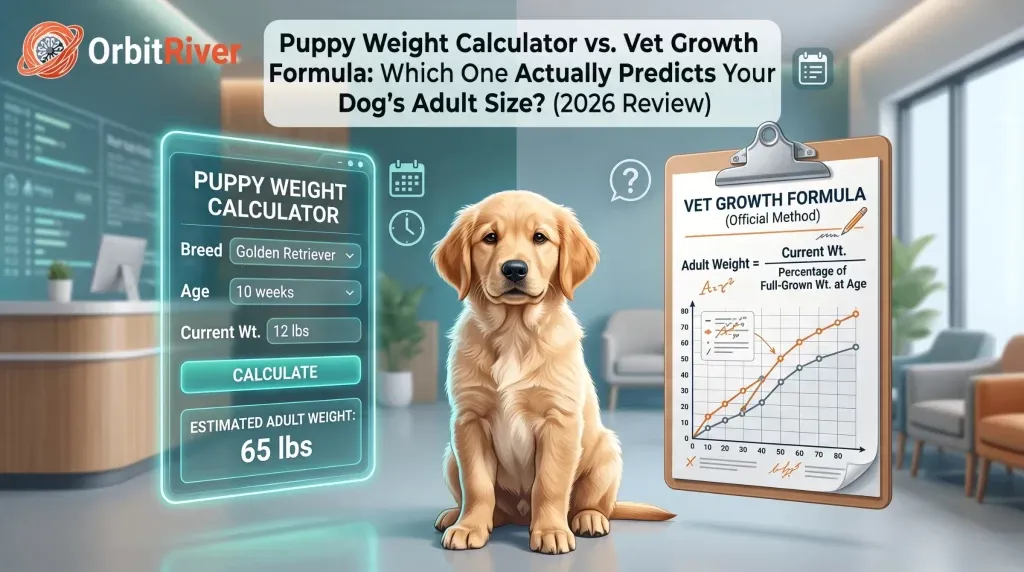
A reliable puppy weight calculator will tell you in less than 10 second what an experienced breeder’s estimation or a thread on a forum and three contradicting blog posts aren’t able to tell you. But how much do you believe it? We evaluated the most commonly used gratis tools against development standards that veterinarians use in clinic. The gap between the most effective and the worst is much greater than the majority of owners think they will.
Here’s the truthful verdict that is backed by the facts to back it.
The short answer
Free calculators built upon growth curves for veterinary use are accurate to within 10-20 percent for purebred dogs. this margin decreases as your dog ages. Tools that rely on the linear formula of the past tend to underestimate the size of breeds and undervalue toy breeds. The assessment of a veterinarian is the most reliable method, since the chart is unable to sense ribcage size or interpret a body-condition score. Calculators are a great tool for planning but consult your physician to make the final decisions.
How the math behind a puppy growth chart works
The 52-week rule (fast, rough, still everywhere)
The formula for classics is easy:
Adult weight = (current weight / age in weeks) x 52
It’s successful because it’s simple to make with napkins. It doesn’t work because the development of a puppy isn’t an even line. A 12-week-old Great Dane run through this formula could end up being incredibly heavy, whereas the Chihuahua that is the same age can be lighter.
There is also a shortcut that suggests to increase the weight by 16 weeks or 4 months in medium dogs. It’s a good guideline for the size class you are in and a bad one for all other classes.
The percentage-of-adult-weight method (what modern tools use)
Better predictors reverse their steps from an upward growth curve. Every size category has an estimated percent of its weight at the age of and a dog size calculator will divide the weight of the dog by that percentage of completion. A medium-sized puppy aged 3 months is approximately 35 percent mature. So twelve pounds today will be around thirty-four pounds by the time you reach the age of maturity.
Why the curve is S-shaped
The pattern of growth follows a sigmoidal arc starting slow at birth The growth rate is rapid between four and six months, followed by an extended plateau phase as the plates of growth shrink. Smaller dogs reach that threshold earlier. This is the reason the growth calculator for a single dog cannot be used to treat an French Bulldog and a Mastiff in the same way.
The data that the most reliable tools provide originates directly from WALTHAM Petcare Science Institute, which produced charts of puppy growth created from approximately 50k healthy dogs. They were later verified in PLOS One with the help of Salt and coworkers. Breed weight ranges generally are based on AKC standard breeds.
Free tools vs. professional vet charts: an honest comparison
| Factor | Free puppy size predictor | Veterinary growth assessment |
|---|---|---|
| Cost | Free, instant, no signup | Consultation fee |
| Data source | WALTHAM curves, AKC weight ranges | Same curves plus physical exam |
| Handles mixed breeds | Ranges only, wider margin | Better, using build and paw size |
| Body condition score | Not measured | Measured directly |
| Catches underweight or failure to thrive | Flags outliers only | Diagnoses cause |
| Best use | Planning food, crate, gear, budget | Health decisions, neuter timing |
There is no rivalry between them. Keep track of your visits at home and let your doctor determine what is off. This is exactly the procedure WALTHAM suggests to clinics.
Do you want to know where the numbers are on your dog? The free calculator for puppy weight that we provide is based on a curve-based model, asking only for the current weight and age and can convert between lbs and kg without the need for a sign-up form.
Growth timeline by size category
| Size class | Adult weight | Roughly 50% grown | Full adult size |
|---|---|---|---|
| Toy | Under 12 lb | 3 months | 8 to 10 months |
| Small | 12 to 25 lb | 3.5 months | 10 to 12 months |
| Medium | 25 to 50 lb | 4 months | 12 to 14 months |
| Large | 50 to 100 lb | 5 months | 14 to 18 months |
| Giant | Over 100 lb | 6 months | 18 to 24 months |
Male puppies usually weigh between 10 and 20% heavier than girls from identical litter. The early neutering process can delay the closure of the growth plate, which is the reason large breed owners often discuss timing instead of choosing to wait until six months.
What about mixed breeds and doodles?
This is the place where most devices are struggling. A Goldendoodle could inherit the Standard Poodle’s frame as well as a Miniature’s. However, the calculator cannot discern the genetics. Two solutions to this problem are:
- The parents are averaged. If both parents have weights the midpoint will usually be more reliable than an age-based estimation on its own.
- Do a weekly weigh-in following the 12th week. Three measurements two weeks apart will reveal the centile line your puppy is following this is the same method that clinics employ to crossbreed their dogs.
For the case of a Labrador, German Shepherd, or another purebred that is predictable breed, the breed information does most all the hard work. If you are looking for the size of a mixed breed puppy calculator, consider the size range as the final answer and rather than the middle point.
Factors that shift the final number
- The importance of nutrition. Overfeeding a large breed puppy can accelerate growth and increases risk for orthopedic problems. This does not increase the size of the dog as an adult.
- Genetics and sexuality. Genetic weight potential is the limit, regardless of the food habits.
- health. Parasites, poor absorption, or even illness could make a curve flat. A puppy who falls across two centile lines is due for an appointment with a veterinarian not an adjustment.
- Status of Neuter and timing. Modest effect on height, more noticeable effect the time when growth ceases.
Using a puppy weight estimator properly: five steps
- Weight using the same scale and at the same time and ideally prior to eating.
- Records are made in weeks not “about the time of.”
- Select breed or size class, if not known.
- Record the results and then repeat it every two weeks for six months.
- Check the trend and not one reading.
The owners who keep track of their progress are able to spot issues early. This is the entire purpose of a growth chart and it is free with the purchase of a notebook.
Why the tool you choose still matters
Numerous calculators are available to convince you to buy something. The ones that are worth bookmarking have three features: they release the data source and display an array instead of an untruly accurate single number and do not restrict results to the email address. Our tool is all three and is a part of other tools in the collection of free tools due to the same reason: good items shouldn’t cost nothing.
Frequently asked questions
How big can my puppy grow if I only know the current the weight of your dog and its age?
An estimator based on curves can offer a reasonable range. The addition of parent or breed weights makes it more precise.
Is a calculator that is free vet-approved?
There is no online tool that can be equivalent to vet advice, but the best ones follow the same standards for growth that the clinic refers to. This is the key distinction.
Can I calculate portions of food based on the forecast?
Yes, when choosing the right formula for your anticipated adult range and to know when it is time to change to adult food. For portion amounts, follow your veterinarian.
Put the number in front of you before you buy the crate
Making assumptions can cost you money. If you buy a crate for an animal you thought would weigh 40 pounds but finding 75 is buying twice. The harness is also a problem, as are that bed as well as the barrier. Two minutes of a predictor that is based on real data from veterinary medicine provides you with a legally enforceable numbers for planning and an increase record that you can give to your veterinarian at the next appointment.
Use your puppy’s data using the adult-weight predictor Keep that tab opened. No account, no upsell, no data harvesting. If it’s helpful us, there are other options worth clicking on for: an fraud checker to check out breeders and pet-supply websites before you make a purchase and the random generator for animals for children who are still deciding on the name of their pet as well as StepFit for when walking your puppy’s growth has made you running. There’s a sophisticated text editor can be found, too for that inevitable announcement of your puppy.
Need help, corrections, or information you believe we should include? Write to business@orbitriver.com. These tools are updated as the science changes.