

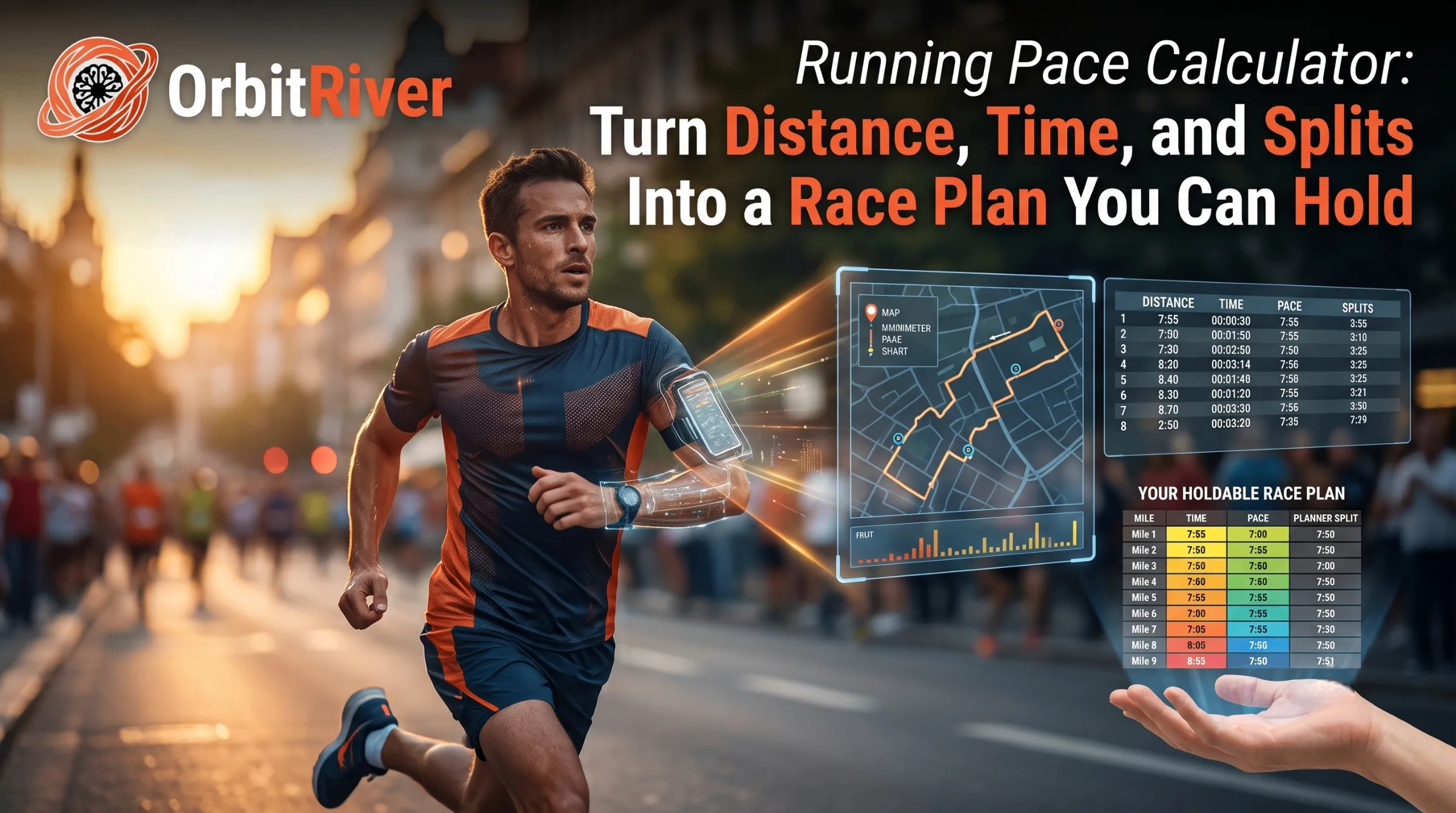

Most runners do not lose a race in the final mile. They lose it in the first two, when adrenaline sets a pace the body was never trained to hold. A running pace calculator fixes that quietly and early, before the start line, by converting three numbers into a plan: distance, time, and pace.
The data backs up why this matters. RunRepeat’s State of US Marathons 2025 report found the average American marathon finish improved from 4:39 in 2019 to 4:34 in 2024, the first meaningful reversal after two decades of slowing times. Better shoes played a part. So did better pacing discipline, and pacing discipline starts with knowing your number.
If you want the number right now, our free pace and time calculator runs in your browser with no signup, no paywall, and no account wall between you and the answer.
What a running pace calculator actually does
Short answer: it solves for any one of three variables when you give it the other two. Enter distance and time, and it returns pace. Enter pace and distance, and it returns your projected finish time. Enter pace and time, and it tells you how far you can run.
The underlying math is one line:
Pace = Time ÷ Distance. Run 5 miles in 40 minutes and your pace is 8:00 per mile.
Everything else, including split tables, unit conversion, and race predictions, is built on that single relationship.
| You already know | You want to find | Real example |
|---|---|---|
| Distance and time | Average pace | 10K in 52:00 gives 8:22 per mile |
| Distance and goal pace | Finish time | 5:00 per km over 21.1 km gives 1:45:30 |
| Pace and available time | Distance | 6:00 per km for 45 minutes covers 7.5 km |
How to calculate running pace from distance and time
- Choose your unit first. Min/km or min/mile, since mixing them is the most common error we see in reader questions.
- Enter the true distance. Use a certified course measurement or your GPS watch, not the race name. A marathon is 42.195 km, or 26 miles and 385 yards.
- Use chip time, not gun time. In a crowded corral the gap can exceed two minutes.
- Read the split table, not just the average. The average tells you what happened. The splits tell you where it went wrong.
Race pace chart: what pace do you need for 5K to marathon?
This is the table most runners screenshot before race week.
| Goal | Finish time | Pace per mile | Pace per km |
|---|---|---|---|
| 5K | 30:00 | 9:39 | 6:00 |
| 5K | 25:00 | 8:03 | 5:00 |
| 10K | 50:00 | 8:03 | 5:00 |
| Half marathon | 1:45:00 | 8:01 | 4:59 |
| Half marathon | Sub 2:00 | 9:09 | 5:41 |
| Marathon | Sub 4:00 | 9:09 | 5:41 |
| Marathon | 3:00:00 | 6:52 | 4:16 |
Notice something useful in rows five and six. A sub-two-hour half and a sub-four-hour marathon share almost the identical pace. The difference is not speed. It is the aerobic base required to defend that speed for twice as long.
Pace converter: min/km, min/mile, and treadmill speed
Runners in the United States think in miles. Runners in Canada, Switzerland, and most of Europe think in kilometres. Treadmills complicate both by displaying speed rather than pace.
| Treadmill speed | Speed in km/h | Pace per mile | Pace per km |
|---|---|---|---|
| 6.0 mph | 9.7 | 10:00 | 6:13 |
| 7.0 mph | 11.3 | 8:34 | 5:19 |
| 8.0 mph | 12.9 | 7:30 | 4:40 |
Why your treadmill pace never matches your GPS watch
Indoors you face no air resistance, the belt reduces the cost of each stride, and consumer treadmill belts drift out of calibration over time. Sports science literature has long supported setting a 1 percent incline to approximate the metabolic cost of outdoor running at moderate speeds. Convert honestly, then race on the number your watch gives you outside.
Race time predictor: the Riegel formula, and how far to trust it
The most widely used equivalent race time model is Peter Riegel’s:
T2 = T1 × (D2 ÷ D1)^1.06
A 25-minute 5K projects to roughly 52:08 for 10K and about 3:59:47 for the marathon. That marathon figure carries one honest caveat: it assumes you have built the long-run volume to support it. A recent machine-learning analysis of more than 117,000 race records, published through the National Library of Medicine, found finishing time depends heavily on factors no formula sees, including training history and course conditions.
Treat a predictor as a starting hypothesis for goal pace. Treat your 20-mile long run as the evidence.
Training paces: easy, tempo, threshold, and interval
A single race pace is not a training plan. The VDOT framework popularised by coach Jack Daniels assigns each session its own intensity, and the same logic runs through most modern training pace calculators.
| Session type | Relative to marathon pace | Purpose |
|---|---|---|
| Easy run | 60 to 90 seconds per mile slower | Aerobic base building |
| Marathon pace | Goal race pace | Race rehearsal |
| Tempo or threshold | 20 to 30 seconds per mile faster | Lactate threshold |
| Interval | Near 5K pace | VO2 max stimulus |
Most recreational runners run their easy days too hard and their hard days too easy. Calculating both properly is the cheapest performance gain available. If you also track walking volume, our steps to miles converter helps you account for the daily load sitting underneath your training week.
Even splits or negative splits?
An even split means each mile or kilometre lands within a few seconds of the last. A negative split means the second half is faster than the first, and it is how most personal bests are actually run. A positive split, where you fade, is what happens when the first 5K feels easy and the calculator was never consulted.
Practical approach: build your split table at goal pace, then plan to run the opening third two to five seconds per mile conservatively slower. Print it as a pace band and wear it.
What about a Boston Qualifier?
Qualification standards tightened for runners under 60 starting with the 2026 race, so an 18 to 34 year old man now needs 2:55:00 and a woman in the same group needs 3:25:00. From 2027 registration, the Boston Athletic Association also applies a time index to steeply downhill courses, adding five or ten minutes depending on net elevation loss. Always confirm current standards on the official B.A.A. qualifying page before choosing a qualifying race, then build your split table around the cutoff rather than the standard.
How our running pace calculator compares
| What matters | Our tool | Typical app-linked calculators |
|---|---|---|
| Account or email required | No | Frequently yes |
| Cost | Free | Free tier with paid upsell |
| Unit switching | Instant, metric and imperial | Sometimes locked by region |
| Splits and finish time | Included | Often gated |
| Mobile friendly | Built for phone use mid-training | Varies |
We publish the formulas we use rather than hiding them, and we apply the same no-signup standard across everything we build, from our website scam checker to the wider free tools library. Results are estimates grounded in standard, widely accepted formulas, and we say so plainly instead of promising certainty no calculator can deliver.
Frequently asked questions
How do I convert 8:00 per mile to min/km?
Divide by 1.60934. An 8:00 mile is approximately 4:58 per kilometre.
What pace do I need for a sub-4 hour marathon?
9:09 per mile, or 5:41 per kilometre, held for the full 42.195 km.
How long will a 10K take at 5:30 per km?
55 minutes, ignoring course and weather variance.
Are race time predictors accurate?
They are reliable between similar distances such as 5K to 10K, and progressively less reliable as you extrapolate toward the marathon without matching endurance training.
Get your pace, then go run it
You do not need another subscription, another login, or another app collecting your training data to answer a question that takes four seconds of arithmetic. Open the running pace calculator, enter two numbers, and get your pace, projected finish time, and split table immediately. Bookmark it on your phone so it is there at the start line, on the treadmill, and during the long run when you are recalculating whether the goal still holds.
If a pacing feature would make your training easier, tell us. Our team builds tools based on what readers actually ask for through the contact page, and you can browse deeper training guides and calculator walkthroughs in our blog library.
Run the number. Then trust it.