
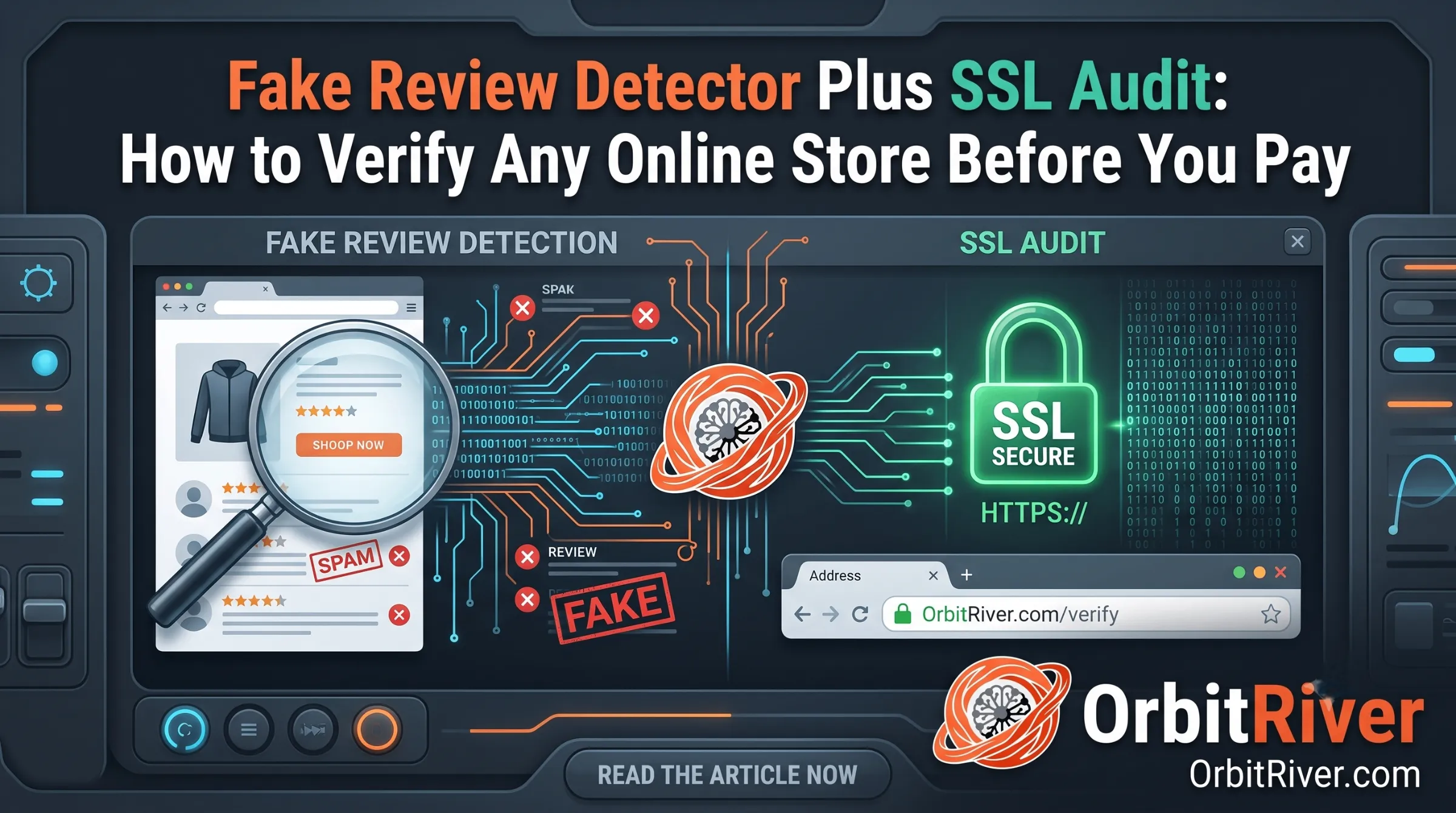
A padlock icon and a 4.8-star rating used to be enough proof for most shoppers. That era is over. A fake review detector paired with a certificate audit is now the fastest way to answer the question people type into Google, Bing, and ChatGPT every single day: is this online store legit?
The numbers explain the urgency. The FBI’s Internet Crime Complaint Center logged more than a million complaints in 2025, with reported losses of roughly $20.9 billion, and non-payment or non-delivery fraud alone accounted for about $503 million of that total (2025 IC3 Annual Report). Meanwhile, Anti-Phishing Working Group data shows well over 90% of phishing pages now display HTTPS. The padlock did not fail. Our assumptions about it did.
The short answer: what a proper store scan looks at
A trustworthy scan combines two independent signals: the authenticity of the social proof, and the integrity of the connection you send your card details through. Reviews tell you whether the merchant exists as a real business. The certificate, domain age, and WHOIS record tell you whether the checkout page can be trusted with your data. Check one without the other and you are guessing.
Want the verdict before you read the reasoning? Paste the address into our website scam checker and read the breakdown. It is free, no account, and the heuristic layer runs in your own browser.
Why “valid SSL” no longer means “safe site”
Here is the detail most shopping-safety articles skip. Certificates come in tiers, and scammers overwhelmingly use the cheapest tier.
| Certificate type | What the authority verifies | Cost and speed | What it tells a shopper |
|---|---|---|---|
| DV (Domain Validated) | Control of the domain only | Free, minutes | Almost nothing about the business |
| OV (Organization Validated) | Business registration details | Paid, days | A vetted legal entity exists |
| EV (Extended Validation) | Deep legal and physical verification | Paid, weeks | Strongest identity assurance |
Keyfactor’s analysis of phishing infrastructure found roughly 90% of phishing sites running DV certificates. Free issuance from services like Let’s Encrypt is genuinely good for the web, and it also means a fake Shopify clone can encrypt traffic within minutes of registration.
Certificate red flags worth ninety seconds of your time
- Expired or self-signed certificate, or a name mismatch between the certificate and the domain
- Mixed content warnings on the payment step, where images or scripts still load over insecure HTTP
- An issuer you cannot identify, or a certificate issued days before your visit
- A weak configuration score when you run the domain through SSL Labs
Click the padlock in Chrome or Edge, open the connection details, and read the issuer and validity dates. It takes seconds once you know where to look, and our learning resources walk through the exact screens.
Reading reviews like an investigator, not a shopper
Fake feedback follows patterns, and patterns are detectable. The Federal Trade Commission’s rule on consumer reviews and testimonials took effect on 21 October 2024 and explicitly covers AI-generated reviews, with civil penalties reaching $51,744 per violation (FTC final rule announcement). Enforcement raised the cost of fraud. It did not remove it.
| Pattern you can see | What it usually signals |
|---|---|
| Sudden burst of five-star ratings in a narrow window | Purchased or incentivised batch |
| Identical phrasing repeated across several reviews | Template text or one author, many accounts |
| Reviewer profiles with no history and no other purchases | Disposable accounts |
| Praise that never names a specific feature | Generic filler, often AI-written |
| Unverified purchase labels dominating the top ratings | Reviewers who may never have bought the product |
| Star average drops sharply once suspicious entries are excluded | Inflated headline rating |
On Amazon, Walmart, and eBay you can filter by verified purchase and sort by recent. On an independent store you cannot, because the merchant controls the widget. That is precisely where cross-checking matters: search the brand name on Reddit, Trustpilot, and the Better Business Bureau, then compare the sentiment there with the glowing testimonials on the product page. A gap between the two is one of the loudest fraud indicators available to a consumer.
A six-step verification routine you can repeat in two minutes
- Copy the full URL, including the path, rather than a shortened link.
- Run the domain through a scan that reads reputation, blacklist, and DNS data in one pass.
- Check domain age via WHOIS or RDAP. A store selling premium electronics from a three-week-old domain deserves suspicion.
- Inspect the certificate on the checkout page, not the homepage.
- Audit the reviews against the patterns in the table above, then verify off-site.
- Test the payment and contact layer. Crypto-only or wire-transfer checkouts, a missing physical address, a copy-pasted refund policy, and an unreachable support email are the classic non-delivery setup.
Steps two and three feel technical, so people skip them. Our free tools hub exists so a shopper with no security background can finish both faster than reading a return policy.
How our scan compares with the tools you already know
| Capability | Orbit River scan | ScamAdviser | VirusTotal | Trustpilot | Norton Safe Web |
|---|---|---|---|---|---|
| Domain age and WHOIS insight | Yes | Yes | Partial | No | No |
| Malware and blacklist reputation | Yes | Partial | Yes | No | Yes |
| Review signal cross-reference | Yes | Partial | No | Reviews only | No |
| Plain-language verdict | Yes | Yes | Technical output | Not applicable | Basic |
| No signup, no paywall | Yes | Yes | Account for API | Yes | Yes |
Each of these is excellent at one layer. A malware engine will not tell you a five-star wall was manufactured, and a review platform cannot see an expired certificate. Combining the layers into one verdict, instead of five browser tabs, is the entire point.
Questions shoppers actually ask
Does this site have a valid certificate?
Click the padlock, open connection security, and confirm the issuer, the domain match, and the expiry date. Valid encryption confirms privacy in transit, not merchant honesty.
Can a scam store have perfect encryption?
Yes, routinely. Encryption protects the data path. Nothing more.
How do I check reviews on a brand-new shop?
Look for the brand on independent platforms and community forums. Silence everywhere except the store’s own page is itself a finding.
Is the tool available outside the United States?
Yes. Shoppers in the US, Canada, Switzerland, the UK, and other English-speaking markets use it daily. More about the team is on our about page.
Should I still buy if one flag appears?
One flag is often innocent. Three or four together is a pattern, and patterns are where money disappears.
Run the check before the card comes out
Fraud works on momentum. A countdown timer, a price too good to question, a checkout that appears before doubt catches up. A ninety-second scan removes that momentum, and it costs you nothing but the pause.
So before your next unfamiliar purchase, paste the store’s address into our free store verifier, read the domain age, certificate status, and reputation signals, then decide with evidence instead of instinct. Bookmark it, and send it to the relative who forwards suspicious links. The same no-signup principle applies to everything we publish, from fraud checks to our step and fitness calculators.
Spotted a store that slipped through, or want a signal added to the scan? Write to business@orbitriver.com or use the contact page. Reader reports shape what we build next.