

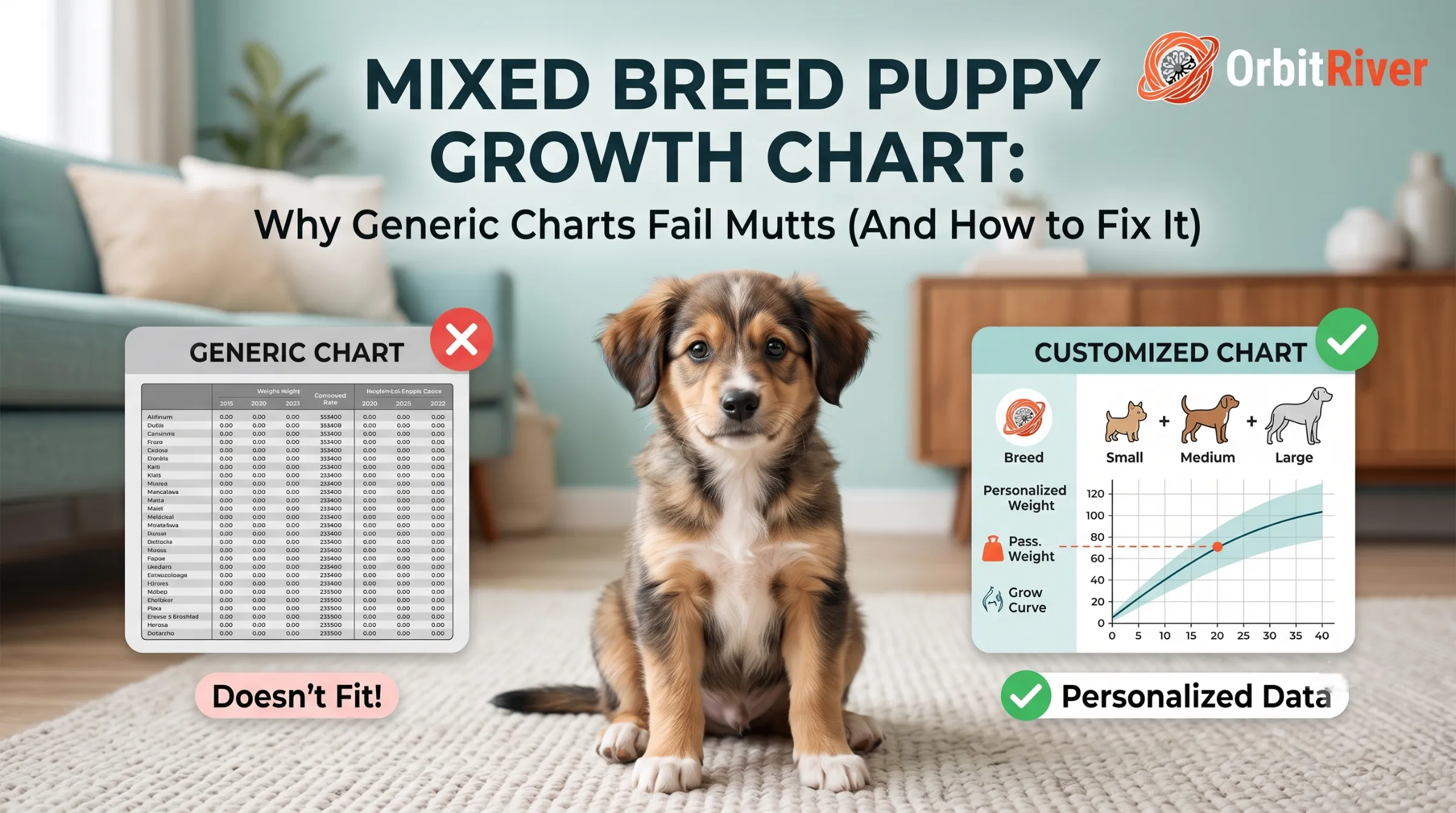
Ask ten new owners how big their rescue puppy will get and you will hear ten guesses. Ask a breed-specific chart the same question and you will get a confident number that is quietly wrong. That gap matters, because a mixed breed puppy growth chart built for one breed cannot describe a dog carrying genes from three or four.
Here is the part most articles skip: the problem is not that charts are bad science. It is that the good science was never organised the way you are trying to use it.
The short answer, before the detail
Standard charts fail mutts because they are indexed by breed, while the peer-reviewed research they come from is indexed by predicted adult size category. Switch from breed thinking to size-category thinking, anchor it with a current weight, and re-check every two weeks. That single reframe turns a guess into a usable range.
Direct answer: For a mixed breed or unknown-parentage puppy, choose a growth curve by estimated adult size category (toy, small, medium, large, giant) rather than by breed, then track your puppy’s weight against that curve every two weeks and adjust the category if the trajectory drifts.
If you want the number right now rather than the theory, our free puppy weight calculator runs on size-category curves and works for mixed breeds with no signup and no email wall.
Why generic puppy growth charts fail mixed breeds
They ask a question your dog cannot answer
A breed chart needs one input you may not have: the breed. The American Kennel Club is refreshingly honest about this, noting that with a dog of unknown heritage, final size becomes something close to guesswork, and especially so between six and ten weeks of age (AKC). Royal Canin’s veterinary academy documents the same problem in practice with a Shepherd × Collie shelter puppy whose growth had to be matched to a 30–40 kg curve by informed judgement rather than pedigree.
The popular formula assumes growth it does not have
The famous shortcut, (current weight ÷ age in weeks) × 52, treats growth as a straight line to twelve months. It is not. Growth follows an S-shaped curve: modest early, steep through roughly four to six months, then flattening as the canine growth plates close. On a large mix, that linear formula routinely overshoots, sometimes badly. The older cousins of that rule, tripling the 8-week weight for small dogs and doubling the weight at 16 weeks for medium and large dogs, are better but still blunt instruments.
Variability in crossbreeds is genuinely wider
Body size in dogs is a multigene trait. Embark reports that roughly seventeen genetic variants account for more than 85% of body size variation across breeds, and that its own weight algorithm lands on target about 80% of the time, with mixed-breed dogs among the populations most likely to be over or underestimated. That is a DNA lab telling you crossbreeds are harder. A generic chart that hides this behind a single tidy figure is misleading you by omission.
Giant mixes fall off the end of the map
The WALTHAM Petcare Science Institute charts, developed from more than six million bodyweight records in a study published in PLOS ONE, cover five size categories up to a predicted adult weight of 40 kg. Above that, researchers found giant-breed growth too breed-dependent to standardise. So a Bernese or Mastiff mix needs an individualised chart, not an off-the-shelf one.
The three-step fix that actually works
- Estimate the size bracket, not the breed. Average the parents’ adult weights if you know them. If you do not, use frame clues at 12 to 16 weeks: bone thickness at the wrist, chest depth, and overall length, rather than paw size alone. Paw size versus body size ratio is a weak signal, useful only at extremes.
- Anchor the bracket with a real weight and age. A percentage-of-adult-weight model works backwards from where your puppy sits on the curve today. Accuracy improves sharply after four months because less growth remains to predict.
- Track fortnightly and let the data correct you. If your puppy climbs or drops across two or more centile lines, the bracket was probably wrong, or something clinical is going on. WALTHAM’s guidance treats a two-centile crossing as the trigger for a veterinary conversation.
Typical milestones by size bracket
| Age | Small mix | Medium mix | Large mix |
|---|---|---|---|
| 8 weeks | ~1.5–3 kg (3–7 lbs) | ~3–5 kg (7–11 lbs) | ~5–9 kg (11–20 lbs) |
| 12 weeks | ~40–45% of adult | ~35–40% of adult | ~30–35% of adult |
| 16 weeks | ~55–60% of adult | ~50% of adult | ~45–50% of adult |
| 6 months | ~85–90% of adult | ~75% of adult | ~65–70% of adult |
| Full size reached | 8–12 months | 12–14 months | 14–18 months |
Treat these as orientation, not prescription. Males typically finish 10–15% heavier than females from the same litter, which alone can move a projection by several pounds.
DNA test or size-based chart? An honest comparison
| Size-category chart or calculator | Dog DNA size prediction service | |
|---|---|---|
| Cost | Free | Roughly $80–150 |
| Time to answer | Seconds | Two to four weeks |
| Works with unknown parentage | Yes | Yes, and identifies the mix |
| Best accuracy window | After 16 weeks | Any age |
| Extra value | Ongoing growth tracking | Health markers, MDR1 drug sensitivity |
| Weakness | Depends on your bracket estimate | Wider error margin on mixes and village dogs |
The practical answer for most owners is both, in sequence: start free today, and order a DNA kit only if breed identity or health screening matters to you beyond size. Wisdom Panel and Embark both report adult weight ranges alongside coat and trait predictions, which is genuinely useful for a rescue puppy of unknown background.
Weight is only half the picture
A number on a scale cannot tell you whether your puppy is well grown or simply heavy. Pair it with a Body Condition Score, the nine-point system your vet uses: ribs easily felt without pressing, a visible waist from above, and a tucked abdomen from the side. Rapid growth in a large mix is not a win. It is associated with skeletal problems including osteochondrosis and hip dysplasia, which is why over-supplementing a big crossbreed puppy backfires.
Watch for these patterns rather than isolated readings:
- Over-growing: two upward centile crossings, ribs hard to locate, no waist. Reassess portions and switch to a large-breed puppy formula if projected adult weight exceeds about 25 kg.
- Under-growing: a flat growth line or downward drift. Rule out parasites and illness with your vet before adding food.
- The lanky stage: a temporary plateau in weight while height and length catch up, usually followed by a filling-out phase. Normal, and not a signal to intervene.
If your household tracks its own numbers too, the same team also maintains a set of step and fitness calculators that follow the same principle: measure, do not guess.
Frequently asked questions
When do mixed breed puppies stop growing?
Small mixes typically finish between eight and twelve months, medium mixes around twelve to fourteen, large mixes at fourteen to eighteen, and giant mixes anywhere up to twenty-four months. Larger frames close their growth plates later.
Does neutering affect mixed breed puppy growth?
Slightly. The PLOS ONE growth-standard analysis found neutering before 37 weeks nudged the trajectory upward and after 37 weeks nudged it down, but both shifts were small compared with normal variation between individual dogs. Timing conversations for large mixes are usually about joints, not final weight.
How accurate are online puppy weight calculators for mixed breeds?
Curve-based tools land within roughly 10–20% for purebreds and somewhat wider for mixes. Any tool promising an exact pound is overselling. A range is the honest output.
Can I still use a chart if I have no idea what my puppy is?
Yes. Pick the closest bracket, log two weights two weeks apart after 12 weeks of age, and let the trajectory tell you whether to move up or down a category.
Start with the number, then make better decisions
You do not need a lab result to start feeding, crating, and budgeting intelligently this week. Enter your puppy’s current weight, age in weeks, and closest size bracket into the free mixed breed weight estimator, and you will have a projected adult range in kilograms or pounds in under a minute. No account, no email, nothing stored.
Then do the thing that separates owners who guess from owners who know: bookmark the page and re-run it every two weeks. Each weigh-in narrows the range. By four months you will have a projection tight enough to buy the right crate once instead of twice, size a harness that still fits at nine months, and know exactly when to move from puppy food to adult formula based on projected size rather than a bag’s marketing copy. Explore the rest of the free tool library while you are there, everything is genuinely free and signup-free by design. If you are buying pet gear from an unfamiliar retailer, run the domain through our website scam checker before you enter card details, and if you are posting growth photos, the fancy text generator is a small, silly pleasure. Between weigh-ins, the random animal generator keeps kids busy.
Questions about tracking an unusual growth pattern? Reach the team at business@orbitriver.com. For anything clinical, your veterinarian remains the final authority, and these tools are built to make that conversation better informed, not to replace it.