

Private investigator AI has really stepped up as a key player in the world of investigations these days. With 2025 here, artificial intelligence brings some serious game-changers that help pros dig through huge piles of data, spot those sneaky patterns, and wrap up cases faster than ever before. This piece dives into the best AI tools out there for private investigators, pulling from solid industry knowledge to give you a full rundown. No matter if you’re a veteran in the field or just starting out, getting a handle on these tools can make a real difference in how you handle your work.
Understanding Private Investigator AI
When we talk about private investigator AI, we’re looking at artificial intelligence setups built specifically for investigative tasks. These setups rely on machine learning, neural networks, and automated systems to tackle jobs that used to take hours of hands-on effort. Take analyzing online trails or forecasting actions, for example, or even checking if evidence is the real deal. What sets these apart from everyday AI is their focus on sticking to legal rules and delivering spot-on results that hold up in professional settings.
Think about the gap between regular AI detective software and basic search tools. A simple engine pulls up whatever’s on the surface, but these advanced platforms for investigators go deep into all kinds of data, turning it into something you can actually use. That kind of edge is vital for building strong expertise in areas like keeping an eye on things or pulling together intel.
The Ways AI Is Changing Private Investigation
Artificial intelligence has flipped the script on how private investigation works by handling the boring stuff automatically and opening doors to smarter insights. Private investigators turn to AI-powered investigation tools for evidence analysis that can plow through video footage or stacks of files in no time flat. This change cuts down on mistakes people might make and frees up time for the big-picture thinking.
A big part of this shift shows up in gathering intelligence. Tools designed for intelligence gathering investigators pull info from places like social media and open records to create detailed overviews. Predictive analytics, for one, can point out possible dangers in fraud probes or searches for lost folks. As things move forward, weaving AI into private investigation workflows turns into a must-do for anyone wanting to keep pace.
Picture this common headache: dealing with the flood of digital info out there. AI steps in with flexible fixes that keep ethics in check, making sure probes are complete but still honor privacy regs.
Key Advantages of Using AI in Private Investigation
Bringing AI on board offers a bunch of upsides for private investigators. It boosts precision in things like background checks, where AI software for background checks investigators cross-checks details from various sources. It also ramps up speed in surveillance, as AI helps private investigators in surveillance by watching automatically and flagging odd stuff.
On top of that, it saves money since automated PI tech means less grunt work by hand. And it sparks new ideas, like with cognitive tools for investigators that run through possible outcomes to plan better. All these perks together lift the standard of detective work, turning AI into a go-to partner.
Imagine a scenario where you need to review evidence quick. AI-driven sleuthing tools pick out mismatches that could slip by otherwise, leading to solid wraps on cases.
Machine Learning’s Impact on Investigations
Machine learning stands out as a major force in today’s private investigations, letting systems pick up from data and get sharper as they go. Machine learning algorithms spot trends in big data sets, like catching weird spots in money trails or guessing where a suspect might head based on past moves. This tech gives private investigators a leg up in tricky situations where old-school ways don’t cut it.
In fraud cases, for instance, machine learning sifts through deals to highlight suspicious ones, giving clues that steer the next steps. Private investigators get a lot from these algorithms because they adjust to fresh data, keeping things lively and on point.
Combining AI with Digital Forensics
Digital forensics sits at the heart of modern private investigation, especially as cyber threats keep growing. AI boosts digital forensics by automating how data gets pulled and reviewed from gadgets, all while keeping the chain of custody tight with audit trails. These tools safeguard evidence so it stays reliable and gets processed fast.
Private investigators lean on digital investigations to find buried details in emails, docs, or cloud environments. AI-powered tools make forensic imaging smoother, helping recover wiped files or rebuild event sequences. This blend ensures evidence stands up in legal spots, meeting tough compliance requirements.
Leveraging OSINT Tools and Social Media Insights
Gathering open-source intelligence is a core part of what private investigators do, and AI takes it to another level with dedicated OSINT tools. These scan freely available data online, including social media, to put together in-depth profiles. Social media analysis driven by AI uncovers links, spots, and habits that shape probes.
AI agents, for example, keep tabs on public shares for threat detection, warning about potential cyber threats or dangers. Private investigator databases powered by AI gather facts from different places, simplifying checks without all the manual hassle.
Streamlining Case Management Through AI
Keeping cases organized is crucial for private investigators to manage info and track how things are going. Case management software with AI built in automates flows, from doling out jobs to putting together summaries. This setup lets legal teams and cybersecurity teams work together without hitches, keeping channels secure.
AI in case management handles document analysis and contract review too, spotting important parts or gaps on its own. For internal investigations or VIP protection, these tools deliver updates right away, speeding responses and boosting overall performance.
Exploring Video Analysis and Surveillance Enhancements
Video analysis has become indispensable in private investigation, with AI making it possible to process surveillance data efficiently. Tools that incorporate anomaly recognition can scan footage for unusual events, saving investigators from watching endless hours manually. Behavioral AI adds another layer by interpreting actions in videos, which helps in predicting threats or verifying alibis.
Remote monitoring systems enhanced by AI allow for real-time oversight, integrating with GPS-enabled tracking for precise location data. This combination proves especially useful in dynamic situations, like following leads in urban areas or monitoring assets over long distances.
Addressing Cyber Intelligence and Security Data
Cyber intelligence forms a growing part of private investigator work, where AI tools help sift through security data to identify vulnerabilities. Cyber experts rely on these systems to detect email spoofing or monitor dark web reports for mentions of clients or cases. Tools focused on cloud-native security protect data in virtual spaces, ensuring investigations don’t expose sensitive information.
Incident response gets a boost from AI, which can automate initial assessments and suggest containment steps. Vulnerability assessment tools scan for weak points in networks, helping prevent breaches that could compromise ongoing probes.
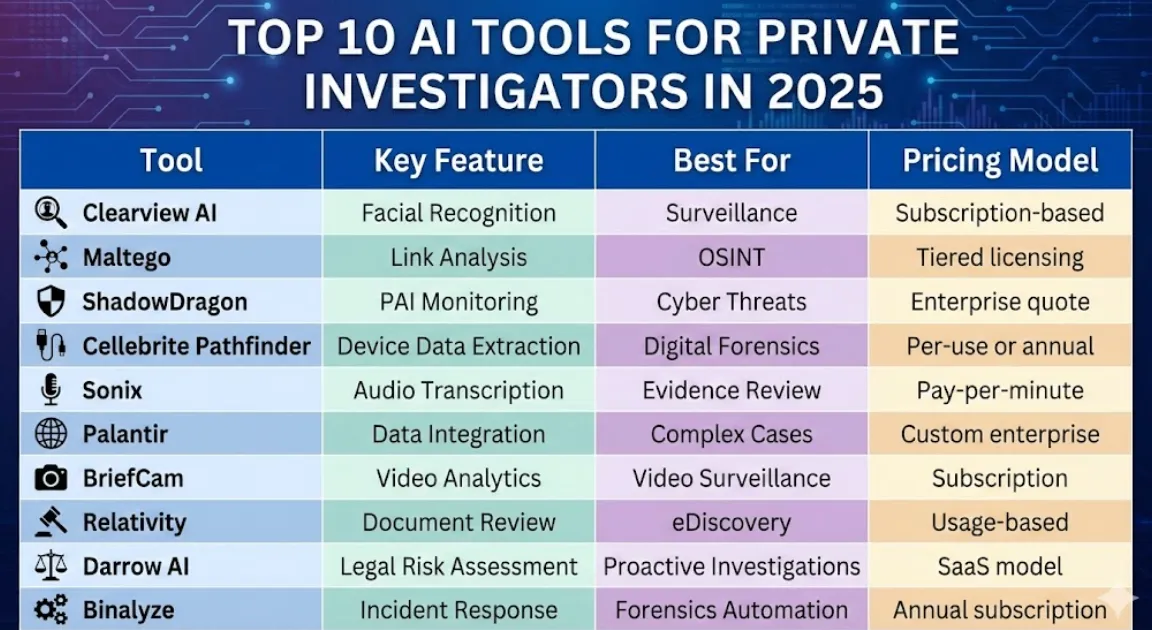
Top 10 AI Tools for Private Investigators in 2025
Drawing from the latest trends and expert takes, here’s a lineup of standout AI platforms for private investigators. The picks zero in on strengths in OSINT, facial recognition, cyber investigations, and evidence analysis, covering a wide range of needs.
1. Clearview AI
Clearview AI shines as a leading choice for the best facial recognition AI for investigators in 2025. It combs through massive public image collections to pinpoint people fast, helping locate suspects or confirm witnesses. Suited for watch operations, it links up with enforcement databases and stresses ethical practices to steer clear of privacy issues.
2. Maltego
Maltego delivers strong link mapping for AI tools for OSINT private investigators. It shows ties between people or groups, ideal for charting out nets in cyber probes. Folks in the field value how it pulls data from open spots automatically, beefing up intel without the drag of doing it by hand.
3. ShadowDragon
As a prime pick for AI platforms for cyber investigation in 2025, ShadowDragon zeros in on watching publicly available info. It stands out in spotting threats live and linking details, backing ethical AI tools for private investigation with a focus on keeping data private.
4. Cellebrite Pathfinder
Cellebrite Pathfinder thrives in digital forensics, pulling and breaking down data from gadgets for evidence checks. It smooths out work across multiple devices, aiding detectives in finding key bits in scams or online matters.
5. Sonix
Sonix handles AI-boosted transcription for sound and sight evidence, turning recordings into text you can search. Counting among the top AI tools for evidence analysis, it works with different languages, guaranteeing precision in varied setups.
6. Palantir
Palantir pulls together scattered data for thorough reviews, proving key for tangled probes. Its machine learning side forecasts trends, fitting right in with AI predictive analytics for detective work.
7. BriefCam
BriefCam changes up video watch with AI that shrinks clips and spots happenings on its own. Essential for handling big evidence loads, it gives fast overviews without losing bits. It aids video analysis by marking crucial points, like oddities in watch data.
8. Relativity
Relativity leads in eDiscovery, employing AI to scan docs and flag what’s important. It upholds legal standards, earning trust for cases packed with proof.
9. Darrow AI
Darrow AI targets legal smarts, hunting for case chances and hazards via data digs. It supports forward-thinking probes, especially in business or trickery spots.
10. Binalyze
Binalyze automates forensic work with AI-led incident response, speeding up proof grabs. Its quickness and accuracy suit urgent cyber dangers well.
| Tool | Key Feature | Best For | Pricing Model |
|---|---|---|---|
| Clearview AI | Facial Recognition | Surveillance | Subscription-based |
| Maltego | Link Analysis | OSINT | Tiered licensing |
| ShadowDragon | PAI Monitoring | Cyber Threats | Enterprise quote |
| Cellebrite Pathfinder | Device Data Extraction | Digital Forensics | Per-use or annual |
| Sonix | Audio Transcription | Evidence Review | Pay-per-minute |
| Palantir | Data Integration | Complex Cases | Custom enterprise |
| BriefCam | Video Analytics | Video Surveillance | Subscription |
| Relativity | Document Review | eDiscovery | Usage-based |
| Darrow AI | Legal Risk Assessment | Proactive Investigations | SaaS model |
| Binalyze | Incident Response | Forensics Automation | Annual subscription |
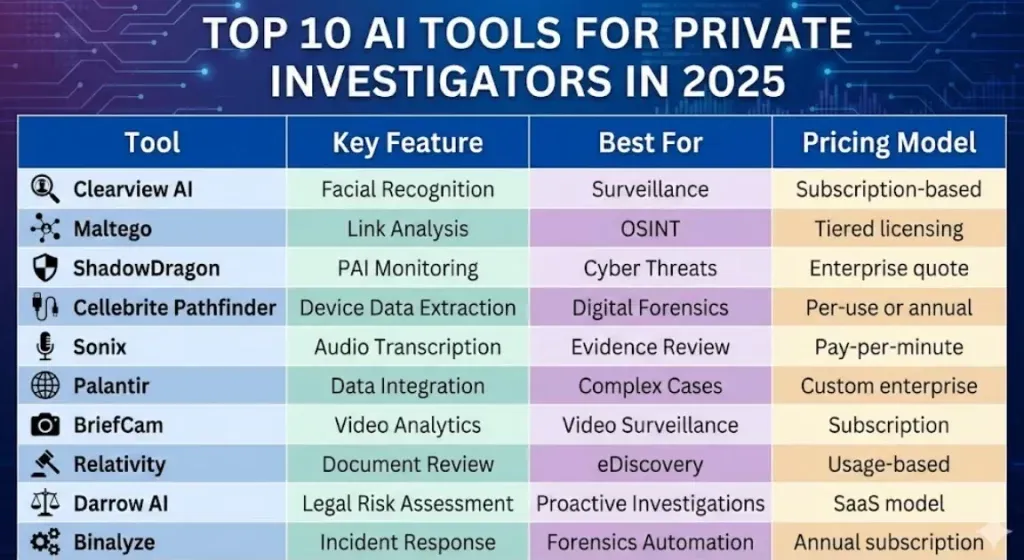
This chart breaks down how each fits into daily flows, making side-by-sides easy.
Other Tools Worth Considering for Specialized Needs
Outside the main ten, a few more tools stand out for their focused roles in private investigation. Magnet AXIOM does great in digital forensics, grabbing data from gadgets while holding the chain of custody. Amped FIVE hones in on video analysis, sharpening clips for better evidence finds. Cellebrite UFED targets mobile pulls, backing forensic imaging in digital digs.
Belkasoft X gives full breakdowns for pcs and phones, perfect for cybersecurity teams on cyber intelligence. CrowdStrike’s Falcon NEO spots threats in cloud spots, and Oxygen Forensic Detective pulls security data from apps and gear. These pair well with the list, particularly for handling deepfake technology or synthetic media.
For OSINT, stuff like Tor Browser keeps browsing under wraps, and the Internet Archive holds onto old web stuff. Geo Data tools assist with place-based intel, like GPS-enabled tracking for remote watch systems.
In cyber security, Noma Security and Aim Security tackle anomaly recognition and behavioral AI, while Cato SASE Cloud and Falcon Data Protection fend off critical vulnerabilities. Cyera AI Guardian boosts data leak detection, and SOCRadar Modules handle IOC enrichment and SOAR ties for phishing runs and money data leaks.
OpenText AI Data Platform aids workflow automation, and cyber security tools like endpoint protection are key for vulnerability checks and incident response. For targeted learning, an AI Ethical Hacking Course keeps you sharp on email spoofing and dark web markets. Deepfake detectors and AI deepfake detection tools are musts for biometric analysis in current cases. Groups like National Private Investigators often suggest these to uphold standards in identity access and cloud-native security.
Navigating Ethical Issues in AI-Driven Investigations
AI holds huge promise, but ethical AI tools for private investigation in 2025 need close watch. Things like built-in biases can throw off findings, so private investigators have to double-check with their own smarts. Sticking to rules like UK GDPR, Data Protection Act 2018, and Human Rights Act 1998 builds that needed trust.
Consider if a tool honors agreement and openness. Solid habits include noting AI involvement and sharing it in write-ups, keeping AI-assisted detective work trustworthy. GenAI applications call for careful looks to dodge false info, especially in touchy areas like dark web reports.
Overcoming Challenges When Adopting AI Tools
Jumping into AI isn’t without bumps for private investigators. One big hurdle is the learning curve, where teams need time to get comfy with new systems. Data privacy worries can slow things down too, as ensuring tools meet regs takes effort.
Cost might seem high upfront, but long-term savings from efficiency often balance it out. Integration with existing setups can be tricky, requiring tweaks to workflows. Addressing these by starting small and scaling up helps smooth the path.
Selecting the Best AI Tool for Your Needs
Picking the right AI tool starts with knowing your specific requirements. Look at what gaps exist in your current process, like needing better OSINT or faster evidence analysis. Compare features, ease of use, and support options.
Read reviews from other investigators and test demos where possible. Factor in scalability for growing needs and check for regular updates to stay ahead of tech shifts. This thoughtful approach leads to choices that truly enhance your work.
Real-World Examples of AI in Action
In practice, AI has proven its worth in various cases. One investigator used facial recognition to locate a missing person by matching public images, closing the case in days instead of weeks. Another applied predictive analytics to anticipate fraud patterns, preventing losses for a client.
Cyber investigations benefit too, with tools detecting phishing attempts through pattern recognition. These stories show how AI turns complex challenges into manageable tasks, backed by real outcomes.
The Regulatory Environment for AI in Private Investigation
Rules around AI in private investigation keep evolving to match tech advances. In the US, guidelines from bodies like the FTC emphasize fair use and data protection. Internationally, frameworks like GDPR set standards for handling personal info.
Private investigators must stay updated on these to avoid pitfalls. Compliance not only protects clients but also bolsters credibility. Resources from professional associations offer guidance on navigating this landscape.
Fitting AI Seamlessly into Your Workflow
To get the most from AI, begin by pinpointing where it fits best, maybe starting with top AI forensics software for detectives in proof-packed cases. Get your crew trained, rolling it out gradually from input to breakdown and reports.
For wider AI know-how, check out guides on cutting-edge uses. See how intelligent investigation platforms slot into routine days for easy uptake. If creative AI angles interest you, like mimicking probe scenes, look at the Ultimate Guide to Perchance AI Roleplay. For handling video proof, insights from How to Create Viral TikTok Videos for Free Using LensGo AI help spot tweaks.
Keep things even, with AI backing up human know-how rather than taking over. For keeping sharp, head to Orbit River for extra AI how-tos, or see Is Inspirit AI Worth $1,100+ in 2025? for training value. More on AI Tools for Content Creation can help with reports, and Best AI for Data Analysis aids proof checks.
Looking Ahead to AI Trends in Detective Work
Down the line, neural networks for detectives will push predictive powers further, and smart tools for private eyes will adapt to new dangers like deepfakes. Count on more stress on ethical setups and mixes with augmented reality for on-site tasks.
How does this shake out for your setup? Keeping tabs via trusted outlets keeps you leading, adjusting to shifts that amp up speed and standards. AI-powered OSINT tools will keep growing, bringing stronger data leak detection and shields against cyber threats.
Wrapping up, grabbing hold of private investigator AI with these top picks sets you up strong for 2025. Stressing real-world use and ethics lets investigators gain sharper views and finer outcomes. For fresh AI takes, swing by Orbit River’s blog for bits that fuel your pro path. This mindset educates and cements standing in a digital-heavy arena.